Fuel prices continue to fall
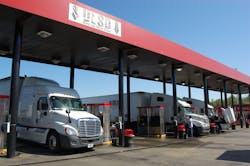
Diesel and gasoline pump prices continued to slide this week across the U.S., despite fuel shortages and subsequent rationing programs established across parts of New Jersey and New York in the wake of Hurricane Sandy.
The average price of diesel in the U.S. dipped 2 cents to $4.01 per gallon, according to data tracked by the Energy Information Administration (EIA) with only the New England and Central Atlantic regions of the country witnessing an uptick in prices – and only 6/10ths of a penny at that, to reach $4.211 and $4.133 per gallon, respectively.
However, compared to the same week in 2011, diesel remains more expensive, costing 12.5 cents more per gallon versus last year, EIA said.
The biggest weekly drop in diesel pump prices occurred in California – 4.3 cents to $4.225 per gallon – while the Lower Atlantic recorded the cheapest price for diesel across the U.S.: $3.91 per gallon on average, the agency noted.
In terms of gasoline, the U.S. average pump price declined 7.6 cents to $3.492 per gallon, according to EIA, though again that is 6.8 cents higher per gallon compared to the same time period in 2011.
All regions of the U.S. experienced a drop in gasoline pump prices, the agency said, with California experiencing a 14.6 cent per gallon decline, the Lower Atlantic seeing a 9.4 cent per gallon drop off, and the East Coast as a whole witnessing a 5.64 cent per gallon dip.
The EIA added, however, that fuel shortages remain a major problem in New Jersey and parts of New York – especially the New York City metropolitan area – due to damage caused by Hurricane Sandy, also known as the “Frankenstorm.”
The agency estimated that 28% of gas stations across the New York City metropolitan area did not have gasoline available for sale as of last Friday, which is in the EIA’s words “a significant problem.”
Some counties in New Jersey, New York City, and Nassau and Suffolk counties have addressed the fuel shortage issue by imposing license plate allocation of gasoline, which the agency noted is being tracked via Department of Energy's (DOE) Helping Local Officials Address Fuel Shortages web page.
A loss of electric power to about 8.5 million customers on the East Coast and the shutdown of two refineries, major petroleum distribution terminals, and pipelines because of power outages and flooding caused by Hurricane Sandy is the major reason for the fuel shortage, EIA said – pointing out that the status of electricity and liquid fuels supply are available DOE’s Hurricane Sandy Situation Reports web page.
Those issues aside, the agency is still projecting lower oil prices for the remaining months of 2012 and into 2013, with gasoline prcies expected to tick up for 2012 and then fall in 2013.
In its Short Term Energy Outlook published last week, the EIA projects that West Texas Intermediate (WTI) crude oil prices will average $89 per barrel in the fourth quarter of 2012, about $4 per barrel lower versus its previous prediction, while Brent crude oil prices are expected to average about $1 per barrel less at about $110 per barrel over the same period.
The projected WTI discount to Brent crude oil, which averaged $22 per barrel in October 2012, should fall to an average of $11 per barrel by the fourth quarter of 2013, the agency noted, with WTI crude oil projected to average $88 per barrel in 2013, while the Brent crude oil forecast remains unchanged at $103 per barrel.
U.S. regular gasoline retail prices are expected to be uneven, though, according to EIA. Following a decline $3.80 per gallon in October down to $3.49 per gallon by November 5, U.S. regular gasoline retail prices are now expected to average $3.56 per gallon during the fourth quarter of 2012.
The agency said one of the ongoing impacts from Hurricane Sandy is higher wholesale gasoline prices on the East Coast, which is expected to continue as the recovery schedule for affected refineries, pipelines, and distribution terminals remains uncertain. As a result, EIA expects regular gasoline retail prices, which averaged $3.53 per gallon in 2011, to average $3.64 per gallon by the close of 2012 before declining to an average of $3.44 per gallon for 2013.
About the Author
Sean Kilcarr
Editor in Chief
Sean Kilcarr is a former longtime FleetOwner senior editor who wrote for the publication from 2000 to 2018. He served as editor-in-chief from 2017 to 2018.