Clark: Why the truck parking shortage remains trucking’s most urgent safety issue
Key takeaways
- Truck parking remains the No. 1 issue for drivers, even as it ranks lower for the industry overall.
- Parking shortages cost trucking over $100 billion annually through lost time, fuel, and productivity.
- Limited parking increases safety risks, HOS violations, and operational costs for carriers.
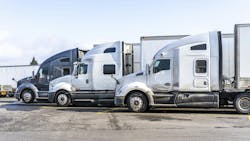
A little over three years ago, I wrote a NationaLease blog about the Truck Parking Safety Improvement Act, a bipartisan effort that promised to address the chronic shortage of legal parking for commercial trucks. At the time, there was optimism that this legislation would finally bring relief to drivers and carriers alike. Yet here we are, years later, and the bill remains stalled. The problem persists, and the consequences are mounting.
The scope of the problem
According to the American Transportation Research Institute (ATRI) Top Industry Issues Report for 2022, truck parking ranked as the No. 3 challenge for the industry overall, while drivers identified it as their No. 1 concern. Fast forward to ATRI’s 2025 report: Parking slipped to No. 4 for the industry, but for drivers, it remains the single biggest issue they face on the road. This disconnect underscores a critical truth: What may seem like a logistical nuisance to outsiders is, in reality, a daily crisis for those behind the wheel.
Why parking shortages matter
For those outside the industry, truck parking might sound like a minor inconvenience. The reality is far more sobering. The shortage costs the trucking industry over $100 billion annually, according to ATRI estimates. That figure reflects lost productivity, wasted fuel, and delivery delays, all of which ripple through the supply chain and ultimately impact consumers.
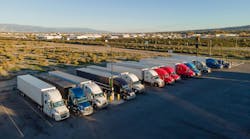
The numbers tell a bleak story. Nationwide, there are approximately 313,000 designated truck parking spaces. Of these, about 40,000 are at public rest areas, while the majority are at private truck stops. That equates to one space for every eleven trucks on the road. Urban space availability for deliveries is always a problem. But after 7 PM, the situation becomes dire, regardless of whether the driver is in an urban, suburban, rural area, or on the highway itself. Over 90% of over-the-road drivers report extreme difficulty finding parking after dark. To make matters worse, 38% of truck tonnage moves through regions that have only 8.5% of available legal parking spaces. The imbalance is staggering.
The human cost
This issue isn’t just about convenience; it’s about safety. In 2009, driver Jason Rivenburg was murdered after being forced to park in an unsafe location. His tragic death led to the passage of Jason’s Law in 2012, which required the Department of Transportation to survey parking availability and develop adequacy metrics. While those surveys have been conducted, meaningful action remains elusive. Drivers continue to face dangerous situations, and security concerns are especially acute for women in the trucking industry. This factor may discourage female participation in long-haul roles.
The ripple effect on carriers
Although parking shortages primarily affect drivers, carriers bear the brunt of the financial impact. Every hour spent searching for a safe parking spot is an hour not spent moving freight. In an industry where time equals money, these delays translate into lost revenue, missed delivery windows, and strained customer relationships. Parking shortages also contribute to hours of service (HOS) violations, further complicating compliance and operational efficiency.
What needs to happen
The solution requires collaboration at the federal, state, and private levels. The Truck Parking Safety Improvement Act remains a critical piece of legislation, but it cannot stand alone. States must prioritize parking infrastructure in transportation planning, and private stakeholders should explore innovative approaches, such as:
- Expanding capacity at existing truck stops through public-private partnerships.
- Leveraging technology to provide real-time parking availability data to drivers.
- Incentivizing the development of secure parking facilities near major freight corridors.
- Integrating parking solutions into urban planning to accommodate last-mile delivery needs.
A call to action
Truck parking is not a “driver problem.” It’s a supply chain, safety, and economic problem. Every stakeholder, from policymakers to shippers, has a vested interest in solving it. Until we move beyond studies and surveys to tangible action, drivers will continue to face unsafe conditions, carriers will absorb unnecessary costs, and consumers will feel the downstream effects.
The time for incremental progress has passed. The industry needs bold, coordinated action to ensure that drivers have safe, legal places to park. Anything less is unacceptable.
About the Author
Jane Clark
Senior VP of Operations
Jane Clark is the senior vice president of operations for NationaLease. Prior to joining NationaLease, Jane served as the area vice president for Randstad, one of the nation’s largest recruitment agencies, and before that, she served in management posts with QPS Companies, Pro Staff, and Manpower, Inc.