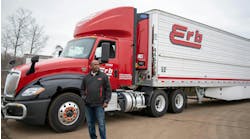
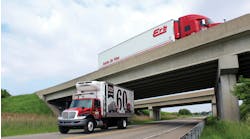
Weight is a very big deal to Jason Hancock. As president of Hancock Petroleum — a third-generation, family-owned fuel hauler — he says his company's tractor-trailers haul the maximum weight allowed in the western province of Alberta, Canada: 63,500 kilograms, which is equivalent to 140,000 lbs.
Without that 140,000-lb. carrying capacity, Hancock says he'd be stuck between a rock and a hard place, unable to haul loads cost-effectively out of Fort McMurray, where oil-rich tar sands are extracted and processed.
"It would require more equipment, manpower, additional operating expense, and yearly safety maintenance expenses if we were limited to the 80,000 lbs. the U.S. allows," he explains, pointing out that the company runs its trucks 24/7 whenever possible by slip-seating drivers, putting over 18,600 mi. per month on its equipment. "In fact, I definitely would like to haul more weight in some applications of my business as it cuts operating expenses. The tractors we are running have 500- to 600-hp. engines and can pull just about anything."
For those very same reasons, U.S. shippers and trucking carriers alike are pushing for a 17,000-lb. hike in federal bridge and road weight limits for commercial vehicles — from the current 80,000-lb. limit to 97,000 lbs.
MORE WEIGHT, FEWER TRUCKS
"An increase in load limits on federal highways will draw heavy traffic away from state and county roads and away from intersections in population centers where the chance of a collision with a car or pedestrian is much greater," says Mike Branch, manager of forest sustainability at Smurfit-Stone Container Corp., and also chairman of the Agricultural Transportation Efficiency Coalition.
"Also, by consolidating loads, that means fewer total trucks on all of the roads and highways," he notes. "Adding fully equipped axles to trucks and corresponding to the extra weight will hold down braking distances and keep the ground pressure on federal highways the same."
The ability to haul more weight could also result in major fuel and wear-and-tear savings for truckers, especially those serving the agricultural, forestry, petroleum and other heavy-haul markets.
"Increasing vehicle weights to 97,000 lbs., if realized, could mean California's fruit and vegetable industry has the potential to experience 160,000 fewer truck trips — equal to 48 million mi. — each harvest," adds Ed Yates, president and CEO of the California League of Food Processors (CLFP). "Add that to the miles that would be saved by the many other agricultural crops hauled each year and the numbers would be even more impressive."
From a technical perspective, it wouldn't take much to upgrade a tractor-trailer so it could haul 17,000 extra lbs., says Darrin Roth, director of highway operations for the American Trucking Assns. (ATA). Adding an extra axle to the trailer would be enough to disperse the impact of that extra weight, preventing damage to roadway pavement, while providing additional braking power so stopping distances are not compromised.
"No change is needed to the horsepower or torque of current engines to haul an extra 17,000 lbs.," he says. "The engine models and trucks out there today are more than capable of handling more weight."
Not so fast, says Todd Spencer, executive vp of the Owner-Operator Independent Drivers Assn. (OOIDA). "That much extra weight completely changes the handling characteristics of the tractor-trailer, how it corners, how it maneuvers, etc.," he explains. "It makes driving an 18-wheeler that much more challenging, and we already don't train drivers adequately anymore before we put them out on the road behind the wheel of a tractor-trailer."
More carrying capacity also doesn't compute from a dollars-and-cents perspective for truckers, Spencer claims. "The last time we changed weight limits was back in 1982 [when all states adopted 80,000 lbs. as the weight limit on all highways] and virtually overnight every federal and state fee associated with truck weights doubled or even tripled," he says, thus almost negating any potential gain in revenue from higher tractor-trailer carrying capacity. "Economically for truckers, raising weight limits would be suicide."
According to the U.S. Dept. of Transportation, one of the driving forces behind the pitch to increase federal truck weight limits is the desire to "match up" with the rest of the world, as the 80,000-lb. (36.3 tons), tractor-trailer weight limit in the U.S. is below Europe's limit of 97,000 lbs. (44 tons); Canada's average of 103,000 lbs. (46.5 tons); and Mexico's limit of 107,000 lbs. (48.5 tons).
GLOBAL DISCONNECT
This disconnect leads to a whole host of problems at land border crossings and seaports, where regular 40-ft. marine containers loaded within international ISO weight limits are overweight on most U.S. roads without special permits and paperwork.
"You've got shipping containers coming into ports that are legal on European roads but are overweight when they arrive here," explains Jake Jacoby, executive director of the lobbying group Americans for Safe and Efficient Transportation (ASET). "This creates a logistical and competitive disadvantage for the U.S."
It's also one reason why, for the first time in a long while, many members of Congress are warming up to the idea of raising federal highway weight limits.
"In my state, the main roads from Canada allow higher weights, so trucks coming from there cannot use the highways and must be diverted to secondary roads. That's a safety issue," says Rep. Michael Michaud (D-ME). "It's also an economic competitiveness issue when the countries we trade with can load their trucks to 100,000 lbs., while we are limited to 80,000 lbs. That's why I'm encouraged by the willingness of Congress to be open about this issue."
The payoff for truckers and shippers, of course, is higher productivity with lower costs, notes Richard Lewis, president of the Forest Resources Assn. He points to a study by a major pulp and paper manufacturer that calculated the benefits of increasing truck gross vehicle weight from 80,000 to 97,000 lbs. just for inbound trucking alone to 18 of its U.S. mills. Extrapolating from that study, Lewis says inbound pulpwood transport costs alone — a tiny fraction of the overall trucking market — would drop significantly from this weight limit increase.
Other benefits of the study cited by Lewis include the following:
- Total decline in diesel use: 13.9 million gal./yr.
- Reduction in total U.S. truckloads: 1.3 million per year.
- Reduction in total annual miles driven: 69.5 million.
- Reduction in carbon dioxide emissions: 242.3 million lbs./yr.
- Potential savings to U.S. pulpwood supply chain per year: $168.5 million.
MORE PRODUCTIVE
"This is a solution that improves productivity without massive infrastructure investments — and trucking is willing to pay for it," ASET's Jacoby says. "We're reducing fuel consumption, reducing emissions and reducing the impact on infrastructure by adding a sixth braking axle to the vehicle — without putting safety at risk."
The other key is a willingness to pay higher fees, primarily by raising the heavy vehicle use tax (HVUT) above its current $550 limit, to gain higher weight limits, he stresses, which is something the trucking industry hadn't been willing to consider before. "That makes this a net income benefit to the federal government," Jacoby points out. "That's why we believe it's a win-win for everyone."
Following Britain's lead
An adverse impact on highway safety is one of the major reasons many groups oppose higher truck weight limits in the U.S.; however, according to safety data from Great Britain, more accidents and fatalities don't necessarily occur when truck weight limits are increased.
In 2001, that nation increased its commercial truck weight limits from 41 tons (90,000 lbs.) to 44 tons (97,000 lbs.). Data tracked between 2001 and 2007 showed that while tonnage increased from 1.58 billion to 1.86 billion tons, vehicle miles traveled stayed essentially flat, while the fatality rate for heavy vehicles dropped from 1.9 per 100 million vehicle kilometers traveled to 1.3.
"If we could add an axle and four tires to the trucks delivering finished paper from just one of our mills in the southeast so we could haul 97,000 lbs. — just like in Great Britain — we could reduce the number of weekly truck shipments from 600 down to 450, a reduction of 150 trucks per week," says John Runyan, senior manager of federal government relations for International Paper and co-chair of the Coalition for Transportation Productivity.
"Since each truck weighs 35,000 lbs. empty, that reduction takes over 5.2 million lbs. of load off the roads and bridges in the southeast each week," he noted. "We also cut 94,000 vehicle mi. traveled per week from just this one mill location, reducing fuel consumption by almost 16,000 gal. per week and reducing carbon emissions by more than 300,000 lbs."
All of it without affecting highway safety whatsoever, Runyan believes.
"If safety is the priority that it should be, our proposal [for a 97,000-lb. weight limit in the U.S.] will result in fewer accidents and injuries by dramatically reducing vehicle miles traveled to move a ton of freight," he explains. "When Great Britain implemented a similar proposal in 2001, their ‘tons of goods’ shipped moved steadily up, while their truck-related accident rate moved steadily down. This is exactly the outcome we seek in the U.S."
The driver's concern
One of the biggest questions that needs to be addressed in the heavier weight debate is how drivers are affected, says Tim Brady, a former owner-operator turned author and business consultant.
Adding a third axle to the trailer would increase the maximum allowable trailer weight to 51,000 lbs., exceeding the tractor's allowable designed weight of 46,000 lbs. by 5,000 lbs. This would create a dangerous kinetic force that could easily push the tractor out of control when attempting to stop on icy, snowy or wet road surfaces, says Brady.
"Add to that descending a steep mountain grade in the same conditions, and even an experienced veteran driver will surely be challenged to keep the vehicle under control," he continues.
While adding an extra axle to the trailer spreads out the weight while a commercial vehicle is going down the road, on a parking lot or backing up to a dock, that third axle could cause a tremendous amount of damage as it twists and grinds into the pavement, Brady notes.
"This is called scuffing, which is a phenomenon associated with certain axle configurations where the vehicle's tires drag across the road surface when turning," he explains. "Scuffing is most prevalent in configurations where a trailer is equipped with a group of three or more axles, just the type of configuration being primarily advocated by proponents of increased truck weights. Scuffing is especially damaging to paved surfaces in hot weather, a condition under which one can physically see the pavement buckle and roll up under the massive stress."
Brady, who spent 25 years behind the wheel of a tractor-trailer, adds that raising the third trailer axle in docking/parking lot maneuvering scenarios isn't an option because it will put more weight per square inch on the pavement, thus negating the whole purpose of the third axle.
"Are shippers and receivers going to be willing to beef up the pavement in the dock areas to deal with the greater stresses?" he asks.
Fleets that already run heavier trucks, though, point out that driver experience and extra training are necessary to combat many of these issues.
"Our new employees must have five years of driving experience, and our veteran drivers conduct a three-week mentoring program with all new employees," notes Jason Hancock, president of Hancock Petroleum in Alberta, Canada, whose vehicles haul the equivalent of 140,000 lbs. "We are very conscious of safety and any tools, like disc brakes, to help assist our drivers to be safe over the many miles they travel."